Meet The ARBOR: Ann Arbor’s Mobile Resilience Unit Brings Clean Power and Climate Education to the Community

Ann Arbor’s Sesame Solar-powered mobile resilience unit now has a community-chosen name: The ARBOR. Designed as a self-sustaining solar, hydrogen, and battery-powered unit, The ARBOR is helping the city bring clean energy, shade, education, and resilience resources directly to residents.
Key Takeaways
- Ann Arbor’s mobile resilience unit has been officially named The ARBOR through community input.
- The ARBOR is a self-sustaining mobile unit powered by solar, battery storage, and a hydrogen fuel cell.
- It serves as both a mobile power source and a hands-on classroom for resilience and sustainability education.
- At its April 25 deployment, The ARBOR supported Ann Arbor’s Spring FreeTree Giveaway and Fourth Annual Climate Teach-In.
- The unit demonstrates how Mobile Nanogrids can support everyday community engagement while also strengthening emergency preparedness.

When communities think about energy resilience, the conversation often centers on what happens during an emergency: a power outage, an extreme weather event, a flood, a heat wave, or a disruption that leaves residents and critical services without dependable power.
But true resilience starts before the emergency.
It starts when residents understand the tools available to them. It starts when clean energy is visible, approachable, and connected to everyday community life. It starts when cities invest in flexible infrastructure that can support public events, education, outreach, and emergency preparedness.
That is exactly what Ann Arbor is doing with its mobile resilience unit, now officially named The ARBOR.
Ann Arbor’s Office of Sustainability and Innovations recently featured The ARBOR in The Charging Station, the official newsletter of A2ZERO and the Ann Arbor Office of Sustainability and Innovations. Soft-launched at the A2ZERO Green Fair in September 2025, The ARBOR has now entered a new phase: showing up in the community, supporting local events, and helping residents experience renewable resilience firsthand.
What Is The ARBOR?
The ARBOR is Ann Arbor’s mobile resilience unit: a fully self-sustaining, solar-powered trailer designed to provide clean power, shade, and educational resources wherever the community needs them.
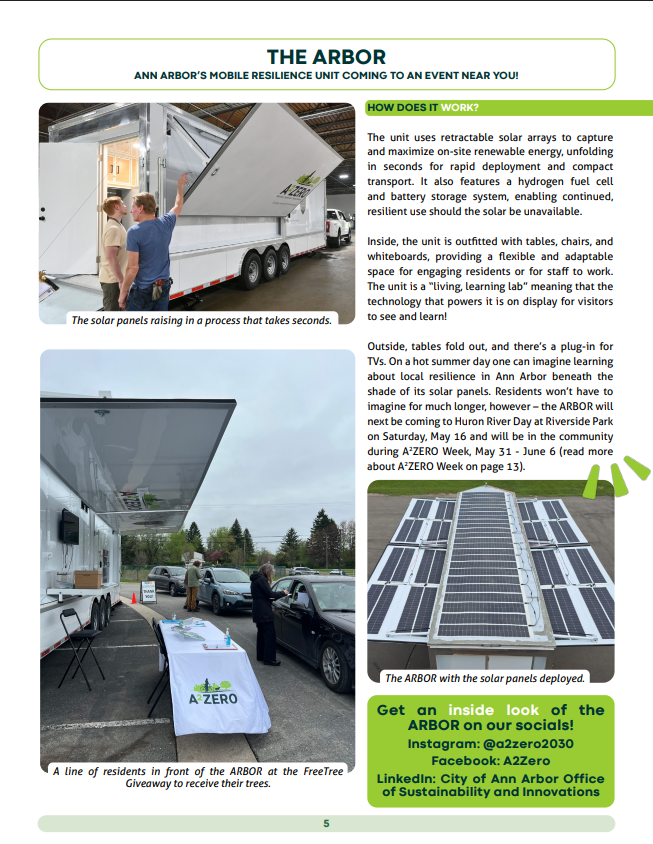
Built with Sesame Solar’s Mobile Nanogrid technology, The ARBOR combines retractable solar arrays, battery storage, and a hydrogen fuel cell to create a clean, mobile power system that can operate independently of the grid.
That matters because resilience is not only about backup power. It is about having a deployable resource that can be moved to where people are, whether that is a neighborhood event, a community education program, a resilience hub, or a location affected by an outage.
Unlike traditional generators that rely on fossil fuel deliveries, The ARBOR is designed to generate and store renewable energy on-site. Its solar arrays unfold quickly for rapid deployment and compact transport, while the hydrogen fuel cell and battery system provide added reliability when solar production is limited.
More Than a Mobile Power Source
One of the most important things about The ARBOR is that it is not being treated as a piece of equipment that sits idle until disaster strikes. Ann Arbor is using it as a community engagement tool and a mobile classroom.
Inside, the unit is equipped with tables, chairs, and whiteboards, creating a flexible space for staff work, resident conversations, and educational programming. Outside, fold-out tables and TV plug-ins help support outreach and public engagement.
The newsletter describes The ARBOR as a “living, learning lab,” meaning the technology that powers the unit is visible and accessible to residents. Instead of hiding the energy system behind walls, The ARBOR makes clean power something people can see, ask about, and understand.
Supporting Ann Arbor’s FreeTree Giveaway and Climate Teach-In
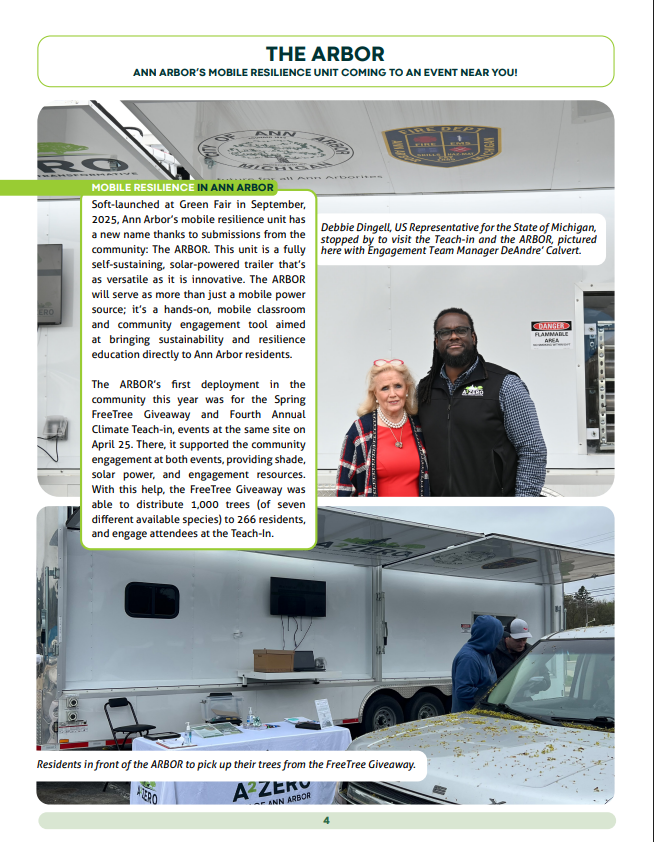
The ARBOR’s first community deployment this year took place on April 25th during two events held at the same site: the Spring FreeTree Giveaway and the Fourth Annual Climate Teach-In.
At the event, The ARBOR provided shade, solar power, and engagement resources. With this support, the FreeTree Giveaway distributed 1,000 trees across seven species to 266 residents, while also helping engage attendees at the Climate Teach-In.
This is a strong example of how mobile renewable energy can support more than emergency response. The same unit that can provide clean backup power during an outage can also help power education, outreach, sustainability programs, and neighborhood engagement.
For cities working toward climate and resilience goals, this flexibility is critical. A mobile resilience unit can be deployed repeatedly across different use cases, helping the community see the value of clean energy before a crisis occurs.
Why Mobile Resilience Matters for Cities
As extreme weather events become more frequent and infrastructure challenges grow, cities need energy solutions that are both reliable and flexible. Traditional backup power often depends on diesel generators, fuel logistics, noise, emissions, and maintenance-heavy systems.
Mobile renewable power offers a different approach.
A solution like The ARBOR can be transported to community events, positioned where residents need support, and used as part of a broader resilience strategy. It can help cities prepare for outages while also advancing sustainability, education, and public engagement.
For Ann Arbor, The ARBOR aligns with the city’s A2ZERO climate goals by demonstrating what local clean energy resilience can look like in practice. It is not just a technology investment. It is a public-facing resilience asset.
A Model for Community-Centered Resilience
The ARBOR also reflects a larger shift in how communities think about preparedness. Resilience cannot be limited to emergency plans that only activate after something goes wrong. It has to be built into everyday community life.
That means creating spaces where residents can learn about sustainability. It means connecting climate action with local services, public events, and trusted community programs. It means making resilience visible.
Ann Arbor’s use of The ARBOR shows how a Mobile Nanogrid can serve multiple roles at once:
- Clean mobile power for events, outreach, and emergency needs
- A resilience education platform where residents can learn about renewable energy
- A community engagement space for staff, residents, and local partners
- A deployable asset that can support the city during outages or disruptions
- A visible symbol of climate action that makes sustainability tangible
For Sesame Solar, this is exactly the kind of use case Mobile Nanogrids were designed to support: flexible, off-grid, renewable power that can serve communities in moments of both everyday engagement and urgent need
As more cities, agencies, universities, and community organizations look for ways to strengthen local resilience, Ann Arbor’s model offers an important lesson: preparedness is not only about having backup power. It is about building trust, awareness, and access before the emergency happens.
The ARBOR is doing just that — one community event at a time..

See how Sesame Solar Mobile Nanogrids can support your community’s resilience goals. Contact Sesame Solar today.
The ARBOR Is Coming to More Ann Arbor Events
According to the A2ZERO newsletter, residents will see The ARBOR at upcoming community events, including Huron River Day at Riverside Park and during A2ZERO Week.
That continued visibility is important. Every deployment gives more residents a chance to experience what clean, mobile, self-sustaining power can do. It also helps normalize the idea that renewable energy is not limited to rooftops, utility-scale projects, or permanent infrastructure.
It can move. It can teach. It can support. It can respond.
For Further Reading
- How Ann Arbor Is Powering Community Resilience with Sesame Solar
- Ann Arbor’s Use of Sesame Solar Nanogrids
- Sesame Solar’s Mobile Nanogrid: A Sustainable Solution for Emergency Response in Ann Arbor
- Ann Arbor Celebrates Sustainability at 25th Annual A2ZERO Green Fair
FAQ: The ARBOR and Mobile Resilience in Ann Arbor
What is The ARBOR?
The ARBOR is Ann Arbor’s mobile resilience unit, a self-sustaining, solar-powered trailer designed to bring clean energy, shade, education, and community engagement resources directly to residents. The unit was soft-launched at the A2ZERO Green Fair in September 2025 and later received its name through community submissions. It is more than a mobile power source. It functions as a flexible space for public outreach, sustainability education, staff work, and emergency preparedness. The ARBOR uses Sesame Solar Mobile Nanogrid technology, including retractable solar arrays, battery storage, and a hydrogen fuel cell, so it can generate and store power on-site. According to Ann Arbor’s A2ZERO newsletter, the unit is also designed as a “living, learning lab,” allowing residents to see the clean energy technology in action.
How does The ARBOR work?
The ARBOR works by combining solar generation, battery storage, and hydrogen fuel cell backup in one mobile system. Its retractable solar arrays unfold quickly to capture renewable energy on-site, making it useful for community events, education, and resilience support. When solar power is limited because of weather, time of day, or other conditions, the battery storage and hydrogen fuel cell help provide continued power. This combination makes the unit more resilient than a solar-only trailer and cleaner than a diesel generator. The unit also includes practical features such as tables, chairs, whiteboards, exterior fold-out tables, and a plug-in for TVs, allowing it to support both power needs and public engagement activities.
Why is Ann Arbor using a mobile resilience unit?
Ann Arbor is using The ARBOR to make clean energy resilience visible, practical, and accessible to the community. Instead of keeping resilience planning behind the scenes, the city can bring The ARBOR to public events where residents can see how renewable energy, battery storage, and hydrogen backup work together. This helps educate the public while also supporting real event needs such as shade, power, and outreach space. The unit can also be valuable during disruptions, outages, or extreme weather events because it is mobile and self-sustaining. For cities pursuing climate action and preparedness, a mobile unit like The ARBOR helps connect sustainability goals with real-world community services.
How was The ARBOR used at Ann Arbor’s Spring FreeTree Giveaway and Climate Teach-In?
The ARBOR’s first community deployment of the year took place on April 25 at the Spring FreeTree Giveaway and Fourth Annual Climate Teach-In. At these events, the unit provided shade, solar power, and engagement resources. Its presence helped support the FreeTree Giveaway, where 1,000 trees across seven available species were distributed to 266 residents. It also supported engagement at the Climate Teach-In, giving residents a chance to interact with the city’s sustainability and resilience work in a hands-on setting. This is a strong example of how mobile renewable power can serve more than emergency response. It can also support education, climate programming, and neighborhood engagement.
Why is The ARBOR considered a “living, learning lab”?
The ARBOR is considered a “living, learning lab” because the technology that powers it is visible and accessible to the public. Residents can see the solar panels, learn how the system captures and stores energy, and understand how hydrogen fuel cell backup can support continued use when solar power is unavailable. This educational role is important because clean energy can often feel abstract or technical. By bringing the system into public spaces, Ann Arbor makes resilience easier to understand. Residents can connect the technology to everyday needs such as powering equipment, creating shade, supporting events, and preparing for outages or emergencies.
How can Mobile Nanogrids support community resilience?
Mobile Nanogrids can support community resilience by providing clean, deployable power where and when it is needed. During normal conditions, they can support public events, educational programming, resilience hubs, field operations, and community outreach. During emergencies, they can help provide power for communications, lighting, medical support, device charging, cooling or heating support, and other essential needs depending on the deployment. Because they are mobile, they are not limited to one fixed site. Because they can generate and store renewable energy on-site, they reduce dependence on fuel deliveries and noisy fossil-fuel generators. This flexibility makes mobile nanogrids especially useful for cities, emergency managers, utilities, universities, tribal communities, and public agencies preparing for extreme weather and power disruptions.
What makes The ARBOR different from a diesel generator?
The ARBOR is different from a diesel generator because it is designed to generate and store clean energy rather than rely on fossil fuel deliveries. Diesel generators can be useful in some emergency situations, but they create emissions, noise, fuel logistics challenges, and ongoing maintenance demands. The ARBOR uses renewable solar power, battery storage, and hydrogen fuel cell backup to provide a cleaner and more flexible alternative. It also serves as a community engagement and education space, which a traditional generator cannot do. This makes The ARBOR both a power asset and a public-facing resilience tool.
Where will residents be able to see The ARBOR?
According to Ann Arbor’s A2ZERO newsletter, The ARBOR is scheduled to appear at Huron River Day at Riverside Park and during A2ZERO Week. These public deployments give residents the opportunity to see the unit in action, learn about local resilience, and experience how mobile renewable power can support community events. Continued appearances are important because they help normalize clean energy technology as part of everyday civic life. Residents do not have to wait for an emergency to understand why mobile resilience matters. They can see it working at public events, ask questions, and connect the technology to Ann Arbor’s broader sustainability and climate goals.
