ERDC Hydrogen Energy Node Installed at Fort Bliss Innovations Lab
Originally published by the U.S. Army Engineer Research and Development Center (ERDC) on March 16, 2026. Article by Sarah Clark, public affairs specialist.
Editor’s Note: We are republishing the following article, originally published by the U.S. Army Engineer Research and Development Center (ERDC), because it documents the installation and operational validation of a hydrogen energy node at Fort Bliss and includes Sesame Solar’s role in training soldiers on system operations, maintenance, and troubleshooting. We are sharing it as a relevant update on real-world energy resilience deployment in a military innovation environment.
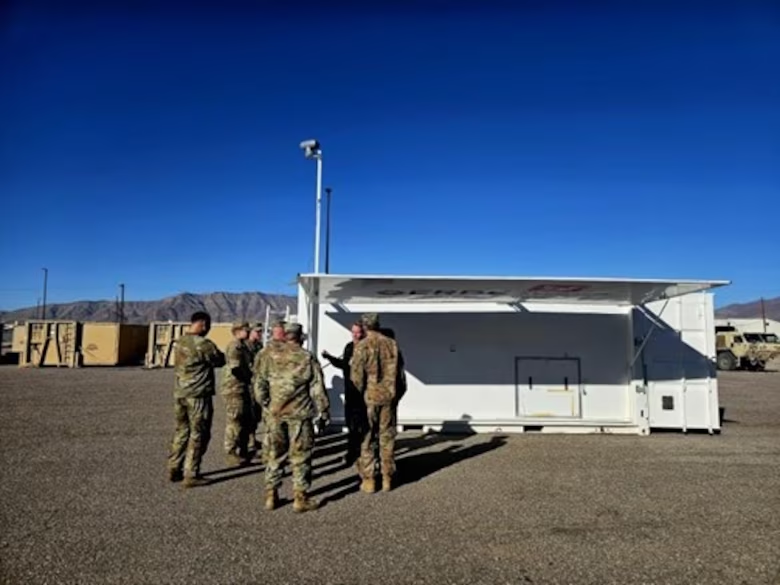
EL PASO, Texas - The 1st Armored Division (1 AD) Innovations Lab, located on Fort Bliss, Texas, is now at the forefront of Army energy modernization following the installation and operational validation of a cutting-edge hydrogen nanogrid, also known as an energy node, developed with industry collaboration at the U.S. Army Engineer Research Development Center (ERDC)’s Construction Engineering Research Laboratory (CERL).
The system was installed at the 1 AD in January, after a year-long demonstration at the White Sands Missile Range (WSMR). With this milestone, ERDC-CERL has accomplished a successful technology transfer that enables the 1 AD to be the first Army unit to possess a fully operational innovation lab powered by hydrogen.
“The Fort Bliss energy node provides a powerful platform for real-world experimentation and operational evaluation, allowing us to refine capabilities alongside Soldiers and extend the practical endurance of these systems for longer-range and more demanding missions,” said Carol Bailey, senior energy engineer at ERDC-CERL and program lead. “Our goal is to ensure this technology delivers resilient, sustainable power that increases operational flexibility and directly supports the needs of the modern Army.”
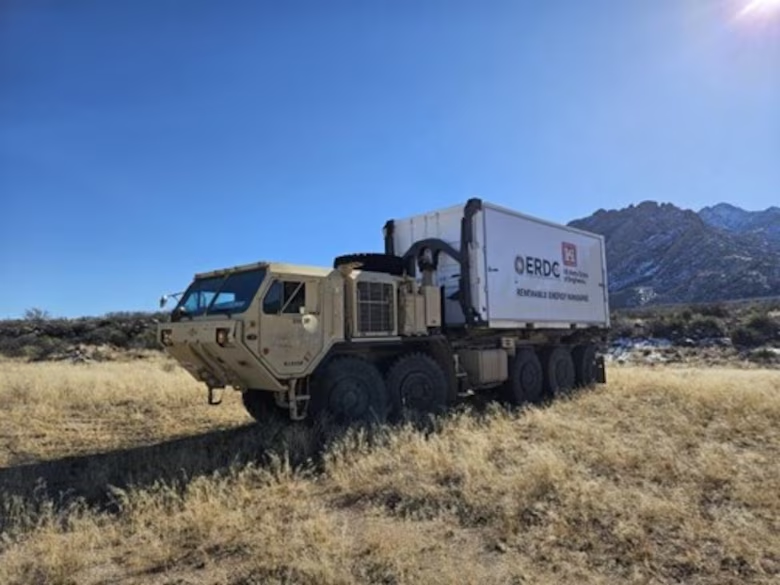
In December 2024, ERDC-CERL unveiled the Army’s first operational hydrogen-powered remote energy node at WSMR, marking a major step forward in resilient, sustainable energy technology. The demonstration was led by ERDC-CERL in partnership with the WSMR Directorate of Public Works Environmental Division and the DEVCOM Army Research Laboratory’s Atmospheric Intelligence for Hybrid Power Advancements team. Designed as a compact, self-contained microgrid, the energy node operates independently of the traditional power grid and replaces conventional diesel generators with clean hydrogen fuel. Housed in a mobile Conex box and equipped with fuel cells, solar panels, hydrogen storage, battery system, an electrolyzer and an atmospheric water generator, the system provided silent, resilient power for remote surveillance unit and meteorological equipment in environmentally sensitive areas. The demonstration at WSMR generated valuable operational data while showcasing how hydrogen-based power solutions can enhance energy resilience for military installations and forward operations.
The hydrogen energy node offers significant operational advantages. The system can provide a mobile, scalable and redundant energy source to forward-operating bases, enabling sustained operations during grid disruption or in austere environments where traditional fuel logistics are limited. The node’s transition from WSMR to Fort Bliss and its readiness for demonstration is a significant achievement in the progress needed to support the Army’s need to explore diverse sources of energy for the current operational environment.
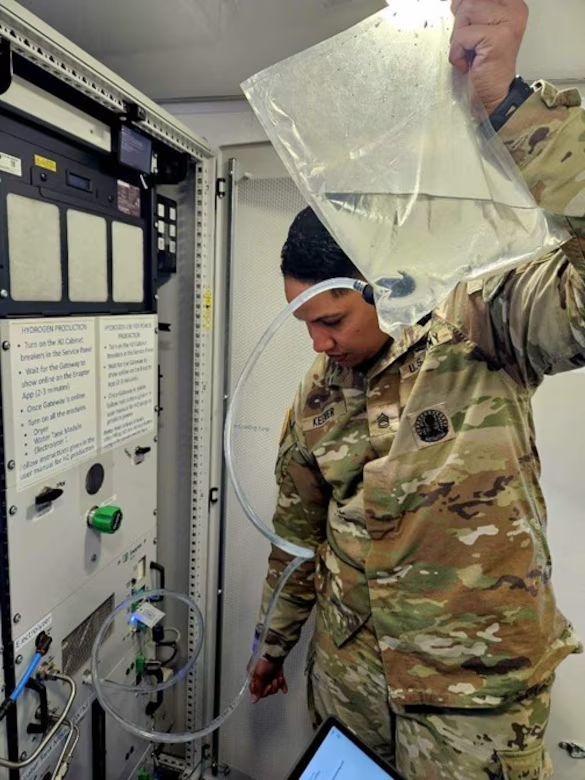
Following the installation, subject-matter experts from industry collaborator Sesame Solar provided hands-on instruction to ten Soldiers assigned to the 1 AD Innovations Lab. The training focused on nominal operations, preventative maintenance and system-level troubleshooting to prepare Soldiers for independent operation of the advanced energy platform.
By day two, the nanogrid was operating at full capacity. The electrolyzer successfully generated hydrogen from distilled water, enabling the integrated fuel cell modules to power the system as designed. Remote monitoring tools were activated, and the platform demonstrated dependable energy generation and storage throughout the remainder of the training. The system ultimately delivered a stable and reliable performance, demonstrating 53 kilowatt-hours of continuous power output — a suitable future option for deployment in operational environments.
The training event also included a high-level demonstration for senior installation leaders. Among those attending the technical walk-around were Fort Bliss Garrison Commander Col. Michael Soyka and Col. Delarius Tarlton, commander of the 1 AD Division Sustainment Brigade. Leadership expressed strong interest in the compact system and its potential for integration with existing tactical and operational assets.
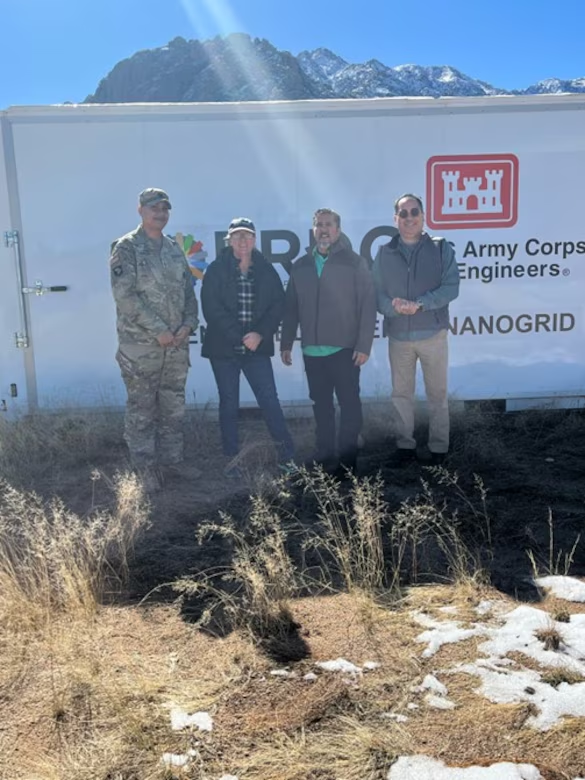
In a written response, Col. Soyka commented on the new nanogrid technology at Fort Bliss after the conclusion of the training event:
Q: What impressed you most during the live demonstration of the system?
A: The ease with which the grid operated to provide power to an important real-world mission; the limited resources required – especially manpower – to operate; and, given its size, the ability to move the capability into a field environment.
Q: From a garrison commander’s perspective, what does hosting this hydrogen nanogrid capability mean for the 1AD and Fort Bliss as a whole?
A: It highlights Fort Bliss’ role in supporting and testing emerging, high-tech energy solutions. Obviously, that’s a big deal given the size of the installation and requirements it has with regards to energy consumption. Creative solutions such as the hydrogen nanogrid may address those needs in the future.
Q: How does this technology align with the Army’s broader priorities for energy resilience and operational readiness?
A: Energy resilience and operational readiness go hand-in-hand. The Army has been focusing on this for quite some time and this shows Fort Bliss takes energy flexibility extremely seriously – that which will go a long way to ensuring operational readiness.
Q: What makes this technology a strategic advantage rather than just a technical innovation?
A: From a strategic and military doctrine perspective, the hydrogen nanogrid energy node represents a shift from logistical dependence to operational self-sufficiency.
The concept and hardware are really impressive, but the strategic advantage lies in three specific areas: 1) Logistical Independence; 2) Radical Reduction in Signature (Acoustic and Thermal Stealth); and 3) Resilience Through Decoupled Storage.
The technical innovation is the nanogrid energy node; the strategic advantage is uninterrupted mission endurance.
Q: What does success look like for this program over the next year?
A: If the Army invests in the technology at depth, we’d love to see additional hydrogen nanogrids gracing the installation. It would provide resiliency the Army is focused on and logistical independence when it comes to energy support of the mission. Also, pairing the nanogrid with the Iron Foundry Advanced manufacturing capability is a natural pairing. As the Iron Foundry matures into a deployable Advanced Manufacturing system capable of printing parts forward the limiting factor will be a reliable power source and the nanogrid has the potential to provide that. The combination of the nanogrid and the Iron Foundry has the potential to lay out a road map for the rest of the Army to follow for forward positioned Advanced Manufacturing in LSCO operations.
ERDC-CERL is continuing ongoing research on hydrogen and fuel cell technologies onsite in Champaign, Illinois, to enhance energy resilience for Army installations. ERDC-CERL will continue to partner with 1 AD to further the innovative technology at Fort Bliss, using their energy node and the ERDC-CERL energy node as platforms for demonstration and operational evaluation. While the current configuration validated the concept, Army stakeholders identified additional power requirements to support high-demand laboratory equipment. The next phase of the project will focus on increasing the capabilities of the energy node to include refueling hydrogen-powered ground-based robotics and air drones.
As Fort Bliss continues to invest in emerging technologies in connection with ERDC-CERL, the hydrogen nanogrid represents a major step forward in expeditionary energy resilience. The collaboration between 1 AD and ERDC-CERL is helping define the future of how the Army generates, stores and delivers power in support of mission success.
“Having served in combat environments where energy security was a matter of survival, I recognize that the hydrogen nanogrid is a critical evolution in localized energy architecture,” says Carlos Molina, energy manager at Fort Bliss Directorate of Public Works. “I appreciate the opportunity to provide continued technical contributions to this innovative initiative as we fortify our operational capabilities.”
“This project is a game-changer,” he continued. “A massive leap forward in localized energy architecture that brings unprecedented resiliency and power to the installation level. I am proud to provide continued technical expertise to such a cutting-edge mission. We aren't just building a power system; we are pioneering the future of tactical energy security. I truly value this high-impact collaboration and can’t wait to see this vision fully deployed.”
This article is republished for informational purposes with attribution to the original source.
Key takeaways
- Fort Bliss is now operating a hydrogen nanogrid, or energy node, at the 1st Armored Division Innovations Lab after a prior year-long demonstration at White Sands Missile Range.
- ERDC-CERL describes the installation as a successful technology transfer that makes the 1st Armored Division the first Army unit with a fully operational innovation lab powered by hydrogen.
- The system combines fuel cells, solar panels, hydrogen storage, batteries, an electrolyzer, and an atmospheric water generator in a mobile Conex-based platform designed for independent operation from the traditional grid.
- Sesame Solar personnel provided hands-on training to ten Soldiers covering operations, preventive maintenance, and troubleshooting, supporting transition to independent use.
- During training, the nanogrid reached full operation and delivered 53 kilowatt-hours of continuous power output, showing stable performance in an operational setting.
- Army leaders framed the system’s value not just as a technical innovation, but as a strategic advantage tied to logistical independence, lower acoustic and thermal signature, and resilient energy storage.
- The next project phase is expected to expand capability for refueling hydrogen-powered ground robotics and air drones, pointing to broader defense and expeditionary use cases.
