This Robotic Arm Could Change How Drones Launch In Combat
By Ishveena Singh | October 8,2026
Originally published on Drone DJ.
A drone can have all the range and capability in the world, but eventually it needs to land, recharge and get back in the air. Three US companies are now trying to remove much of that downtime with a single mobile system designed to keep drones operating around the clock.
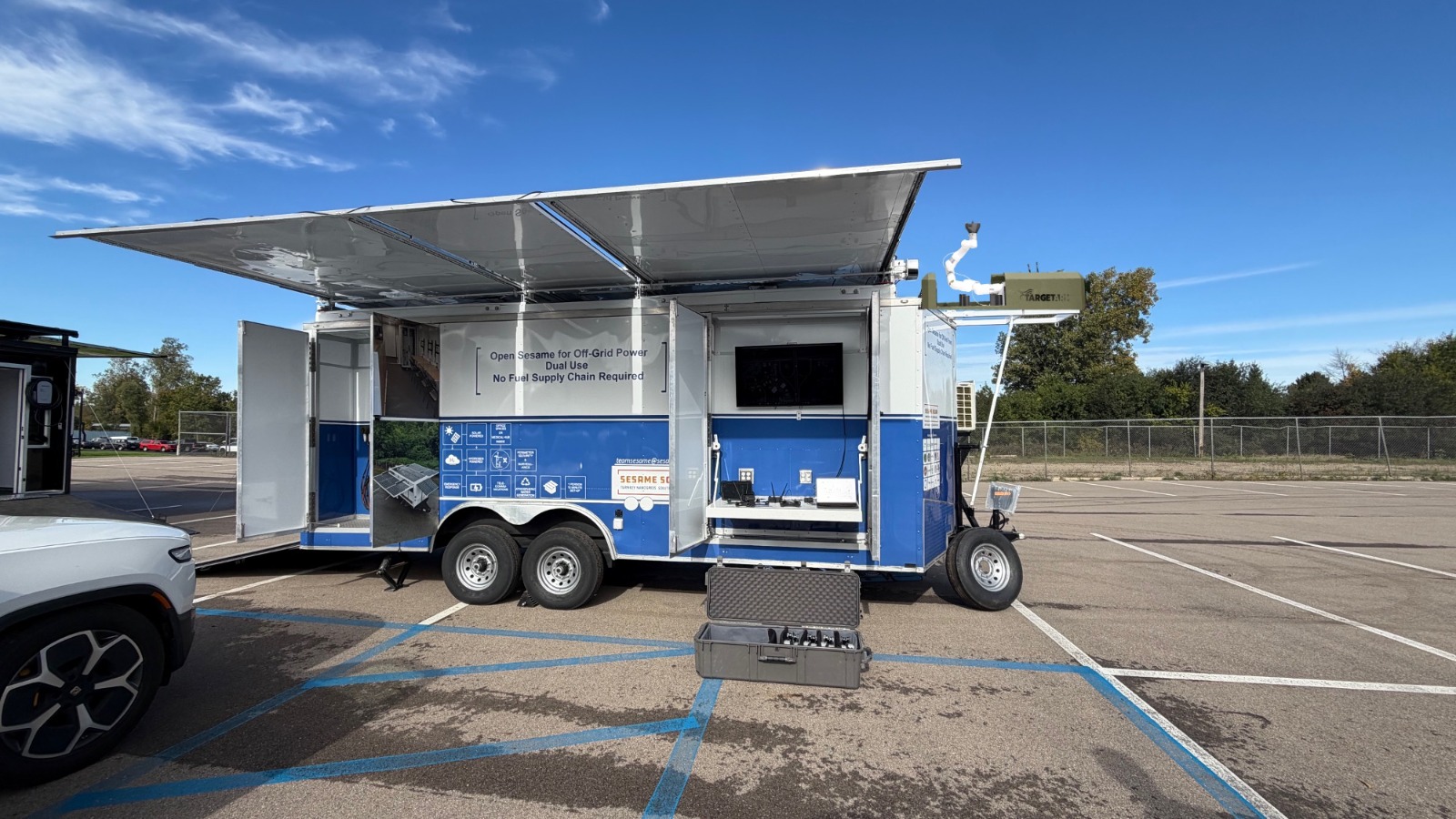
Sesame Solar, Target Arm and AG3 Labs have launched what they describe as the first Made-in-USA Persistent Drone Operations Nanogrid. The integrated system combines mobile power generation, autonomous drone launch and recovery, and configurable small drones into one package for forward and expeditionary operations.
The idea is relatively straightforward: instead of sending personnel out to launch, recover, charge, and redeploy individual drones, the Nanogrid is designed to automate much of that cycle.
At the center of the system is Sesame Solar’s Mobile Power Hub, which uses solar power, hydrogen, and battery storage to generate and store electricity for equipment in the field. The company says its solid-state, low-pressure hydrogen can be transported by land, sea, or air, eliminating the need for conventional fuel resupply.
That matters in remote or contested environments, where keeping a drone battery charged can be surprisingly difficult.
The US Army has previously highlighted the lack of standardized procedures for getting backup power to drone teams in the field. The three companies say their system is intended to address that gap while reducing the need for personnel to remain exposed during drone operations.
Target Arm provides the robotic side of the equation with its Ralar autonomous launch and recovery system. The robotic arm can deploy and recover drones, while integrated drone magazines allow multiple aircraft to be cycled through missions, charging, and storage.
Ralar is also designed to operate from moving vehicles and boats. That means a team does not necessarily have to stop its vehicle just to launch or recover a drone.
AG3 Labs supplies the aircraft through its SPADE platform, a Group 1 small unmanned aircraft system designed to be reconfigured for different missions. The company says SPADE can support intelligence, surveillance and reconnaissance, communications relay and, for defense customers, kinetic payloads.
The platform can also be operated individually or as part of an autonomous swarm, potentially allowing a single operator to manage multiple aircraft.
The companies envision the system being used well beyond traditional military missions. Potential applications include border monitoring, search and rescue, critical infrastructure inspections, disaster response, law enforcement and security operations.
For defense users, the system could support persistent ISR, perimeter monitoring, tactical operations, training, and counter-drone exercises.
The Nanogrid can operate as a standalone unit or as part of a larger configuration. Sesame Solar says two to 12 Nanogrids can be combined to create a mobile microgrid capable of supporting drones as well as man-portable batteries and other forward equipment.
The launch also arrives as Washington pushes for greater domestic production of small drones and reduced dependence on foreign-made systems. By combining US-made power, robotics and aircraft, the companies are positioning the Nanogrid as a domestic alternative for organizations looking to strengthen their drone supply chains.
The bigger pitch, though, is persistence. “Operators shouldn’t need a different drone for every mission,” says Nick Smock, cofounder and head of growth at AG3 Labs. The goal, he added, is to have an airframe that can be reconfigured in the field and deployed in numbers.
If the system works as intended, the drone becomes only one part of a larger autonomous operation — with the power source, launch mechanism, recovery system and aircraft all working together to keep missions moving.
